- Markets & Machines
- Posts
- Project NANDA: The Internet of Agents: Ambition or Overreach?
Project NANDA: The Internet of Agents: Ambition or Overreach?
Exploring the promise and peril of building a networked intelligence.

Kannan Singaravelu
November 02, 2025
Yesterday, I had the opportunity to meet Prof. Ramesh Raskar from the MIT Media Lab, who has been involved in the MIT Project NANDA initiative. I also had a great conversation with Mr. Ashish Chauhan, CEO of NSE India. The discussion explored a simple but powerful question:
Do we really need a new protocol layer like NANDA when so much of the agent world is already standardized?
Over the past few months, MIT’s Project NANDA (Networked Agents and Decentralized AI) has been making waves in the emerging “Internet of Agents” community. Backed by the MIT Media Lab and inspired by the web’s earliest networking principles, NANDA wants to create the infrastructure layer for a world where billions of AI agents can discover, identify, trust, and collaborate with one another.
But in an ecosystem already buzzing with new protocols, from MCP to A2A - many are asking a reasonable question:
Do we really need NANDA? And what practical problem does it actually solve?
Let’s unpack this.
🌐 What Problem Is NANDA Trying to Solve?
Today’s AI agent ecosystem resembles the pre-web Internet: fragmented, closed, and siloed.
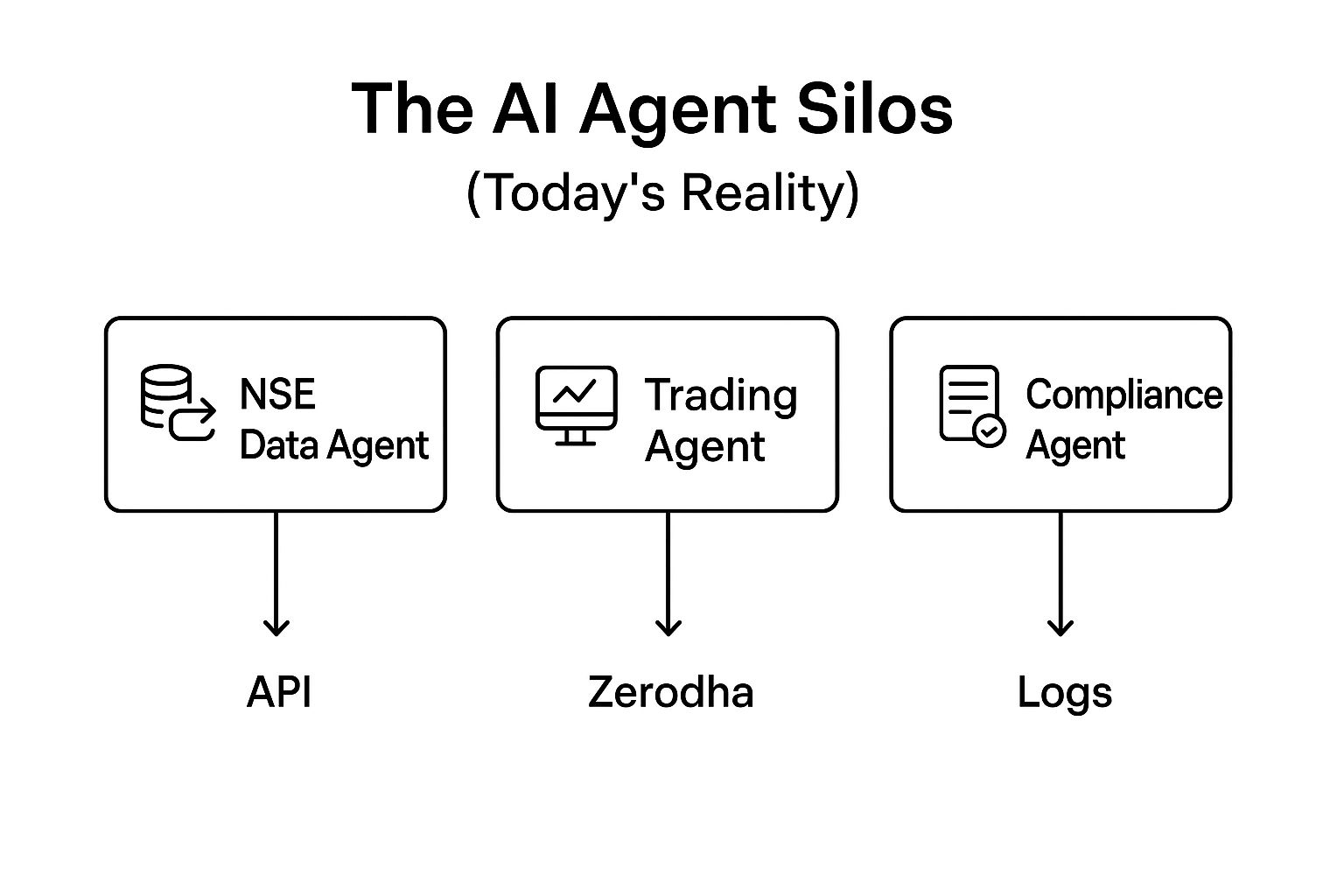
You can deploy your own financial agent that pulls data from NSE India.
Another team may run a trading agent integrated with Zerodha.
Yet another organization builds a research agent for economic forecasting.
Each agent lives in its own micro-universe, connected to proprietary data sources and APIs, unable to discover or collaborate with others unless someone writes a custom integration.
That’s fine for now, but scale it up to millions of autonomous agents performing research, trade, logistics, and communication and you hit four foundational issues that NANDA wants to fix.
1. Discovery
There’s no standard way for agents to find each other.
If your trading agent could discover and query a verified “NSE Data Agent” instead of using custom code, interoperability would explode.
NANDA proposes a decentralized agent registry, think DNS for agents where identities and metadata can be indexed and searched securely.
2. Trust and Verification
How can one agent verify that another is legitimate?
When an agent claims to represent a bank or broker, who confirms its authenticity
NANDA integrates cryptographic identity and verifiable credentials, similar to how SSL certificates authenticate web domains.
3. Coordination and Transaction Protocols
Even if agents can find each other, there’s no shared language or contract for secure collaboration.
How do they negotiate data sharing, payments, or task delegation?
NANDA introduces open interaction protocols for secure, peer-to-peer communication - the equivalent of HTTP and REST for agents.
4. Decentralization and Ownership
Currently, most agent ecosystems are centralized. OpenAI, Anthropic, and Google control identity, access, and interoperability.
NANDA’s architecture aims for a decentralized “Internet of Agents” where anyone can publish, discover, and connect agents without going through a single provider, an echo of the early Internet ethos.
⚙️ A Real-World Example: When You Might (and Might Not) Need NANDA
Let’s take a real case.
You already have:
An NSE Options agent connected to NSE India APIs via MCP server, answering user queries in natural language.
A Zerodha MCP bridge that executes trades based on signals generated by that agent.
In this setup, everything works. You don’t need discovery, identity, or decentralized collaboration - your ecosystem is closed and self-contained.
So where would NANDA help?
Only when your agents need to interoperate beyond your boundary.
Imagine:
Your signal agent wants to verify and consume data from a trusted external “Volatility Index Agent” maintained by a different firm.
You want your model to negotiate portfolio rebalancing with a 3rd-party execution agent or a regulatory compliance agent.
You want to expose your trading signal agent as a trusted service other financial bots can discover and pay to use.
That’s where NANDA’s discovery, identity, and trust layers start to matter. Otherwise, for tightly coupled internal stacks, it’s overhead you can skip.
🧩 How NANDA Differs from A2A and MCP
Feature | MCP | A2A | NANDA |
|---|---|---|---|
Primary purpose | Standardized context exchange between tools & models | Message passing between agents | Global discovery, identity, and trust for agents |
Layer | Application integration | Communication | Network infrastructure |
Topology | Centralized per app | Peer-to-peer | Decentralized network registry |
Trust model | Implicit (within same runtime) | Manual | Cryptographic identity & credentials |
Governance | OpenAI / community driven | Open community | MIT + open consortium |
In essence:
MCP helps your agents talk to your tools.
A2A helps agents talk to each other.
NANDA helps the world of agents find and trust each other.
You could think of MCP/A2A as HTTP/SMTP, and NANDA as DNS + SSL for the agent internet.
⚖️ The case for NANDA
✅ 1. Future-proof architecture
If agents ever become as ubiquitous as web servers, we’ll need an equivalent of DNS, TLS, and PKI for them.
✅ 2. Open, vendor-neutral network
It breaks the emerging monopolies where every agent must register under a specific platform (OpenAI, Anthropic, etc.).
✅ 3. Enables autonomous coordination
Allows agents to discover and transact securely without central oversight, a prerequisite for large-scale autonomous economies.
✅ 4. Builds on existing standards
NANDA isn’t reinventing protocols, it’s aggregating lessons from Web3, W3C DIDs, A2A, and verifiable credentials.
✅ 5. Academic and ecosystem credibility
With MIT Media Lab, open working groups, and early developer tooling, it brings academic rigor and open governance to an otherwise fragmented field.
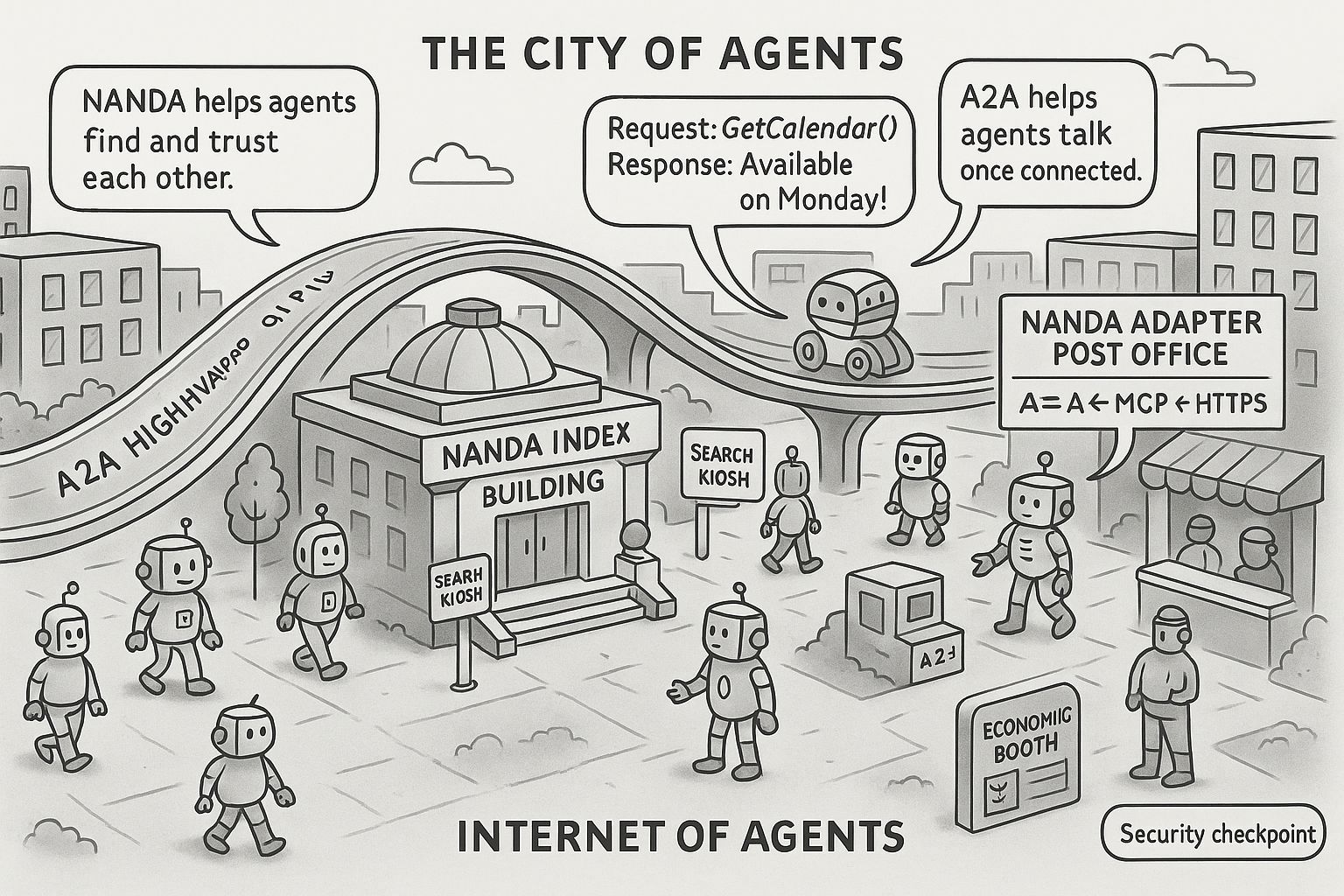
Inspired by Ankur Shinde’s post and illustration on Project NANDA, this image was recreated using ChatGPT by the author, who believes it best represents the essence of Project NANDA
⚠️ The case against NANDA
❌ 1. Premature for today’s market
Most current agents are still single-purpose scripts or closed systems. Discovery and trust networks may be overkill at this stage.
❌ 2. Competing protocols already exist
Between A2A, MCP, LangChain ReAct, and W3C DID/VC standards, the ecosystem is already crowded. Developers may resist yet another layer.
❌ 3. Network-effect barrier
Until many agents join the registry, NANDA’s core value (discovery) remains theoretical, the classic chicken-and-egg problem.
❌ 4. Governance complexity
A decentralized registry sounds great until bad actors exploit it. Defining trust, revocation, and dispute resolution in a decentralized environment is hard.
❌ 5. Tooling and developer friction
Unless SDKs and libraries make NANDA trivial to integrate, adoption will lag behind simpler, platform-specific approaches.
🔍 Will It Take Off?
Realistically, NANDA’s success depends on ecosystem timing.
In 2025-26, most agent workloads remain closed, internal, and task-specific.
But by 2027-30, as organizations begin deploying fleets of interoperable autonomous systems, NANDA’s model could become essential infrastructure.
If it reaches critical mass, a few thousand high-trust agents and interoperable registries, it could evolve into the “DNS + SSL” of the agent web.
Otherwise, it may remain a brilliant but academic blueprint.
🚀 A Balanced View
Dimension | NANDA’s Promise | Realistic Risk |
|---|---|---|
Discovery | Global agent directory | Low participation |
Trust | Cryptographic identity | Complex governance |
Interop | Universal agent protocol | Competes with MCP/A2A |
Decentralization | Vendor-neutral web | Limited incentives for big players |
Adoption | Long-term strategic | Short-term uncertain |
🧭 Final Thoughts
If you’re building self-contained systems like a market-data agent and a trading-execution agent connected through your own MCP stack, you don’t need NANDA today.
But if you believe the future lies in open, composable, autonomous ecosystems, where agents negotiate, transact, and reason across organizations, NANDA is an early glimpse into that world.
The Internet of Agents will eventually need its DNS, its SSL, and its search engine.
Whether NANDA becomes that layer or just inspires it depends on how the community builds from here.
— Kannan